#1 DevOps Bootcamp

The ONLY bootcamp you need to become a DevOps or Cloud Engineer

Join the Program OR DOWNLOAD SYLLABUS
  • 4,289+Students Enrolled
  • 4.9Trustpilot Rating
  • 4-6 monthsProgram Duration
  • 24+Real-life Projects
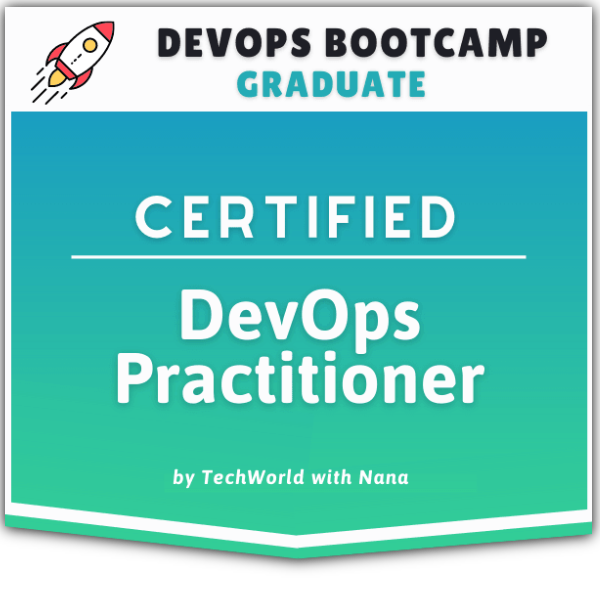
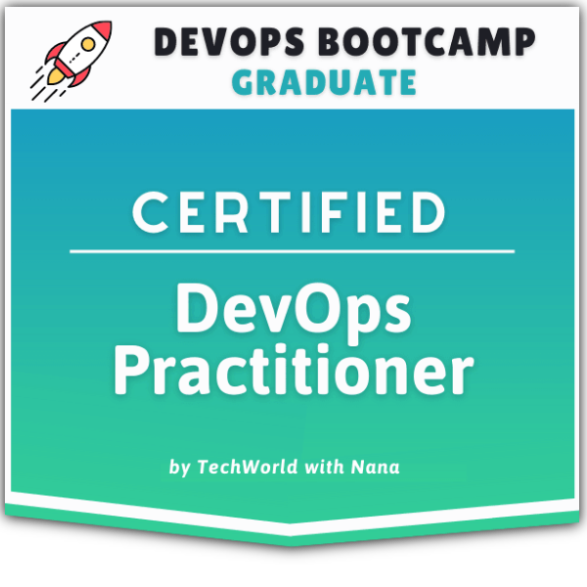
DevOps Practitioner Badge

Become a Certified DevOps Practitioner

  • From Zero DevOps and Cloud knowledge to becoming a proficient DevOps Engineer
  • Certification that proves your practical knowledge
  • Extensive DevOps & Cloud projects portfolio to showcase your acquired expertise

This DevOps Bootcamp is for you, if you want to...

job interview.pngshare achievement.png
  • You want to transition from another engineering role to a highly-demanded DevOps or Cloud career
  • In your first DevOps engineer role, you don’t want to feel like a beginner, you want to be productive and have skills to do actual DevOps tasks at work right away, and are looking for a program that will teach you DevOps with actual real life projects that you can immediately put to work in your job
  • You love DevOps and Cloud and want to get your first job in the field, and you are looking for program that will make you job-ready for DevOps and Cloud career
  • You want to feel great about your DevOps and Cloud skills and wow your co-workers with your knowledge and understanding of the concepts and technologies
  • You already use DevOps and Cloud technologies but you aren’t fully confident with your DevOps skills
  • You know few technologies, but you have knowledge gaps, and are missing a big picture view of things to build complete DevOps processes
  • You are a DevOps team lead, but are missing the technical knowhow to feel confident in your role and do the hands-on DevOps tasks
  • You are a software engineer or sys admin who started taking over DevOps and Cloud tasks, but you are missing essential concepts to understand how to build automated DevOps processes
  • You are looking for an online program that teaches the underlying concepts of DevOps tools, so you are able to use alternative tools if needed. E.g. when you switch job and the new company uses different technologies
space with laptop - learning.png
  • You are overwhelmed by the complexity of DevOps and by the number of technologies you need to learn and want to have an easy way of learning everything with deep understanding of concepts as well as practical hands-on knowledge
  • You are looking for an online program that will give complete DevOps and Cloud knowledge to help you implement them immediately at your work
  • You are searching for a program where instructor teaches everything in detail, without skipping important parts and where you aren’t just copy pasting code without understanding what it does
  • You don’t have much time next to your full-time engineering role to upskill, so you are looking for a self-paced program that will teach you exactly what you need without wasting your time

Best suited for people with these backgrounds

  • DevOps Engineers
  • Software Developers
  • Network Engineers
  • Cloud Engineers
  • Systems Administrators
  • Test Engineers / QA

Who this Bootcamp is NOT for

If you have no IT background, take this IT Beginner course first and come back afterwards :)

Master the DevOps Game

Go from Zero to DevOps Professional

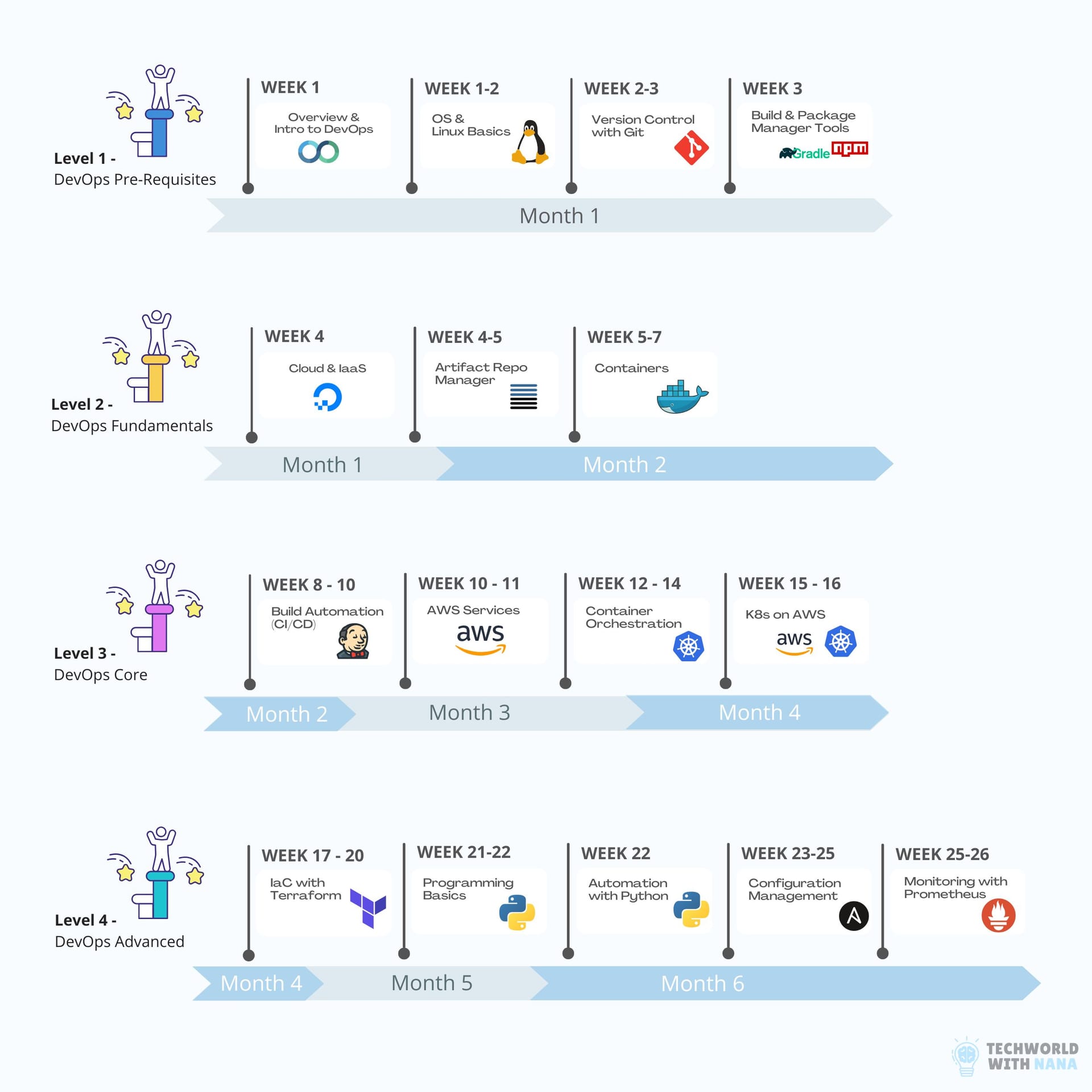
  • Recommended Learning Schedule based on 15 hours/week
  • Self-Paced Online Bootcamp - You can finish faster or take longer
DevOps Bootcamp Roadmap by TechWorld with Nana

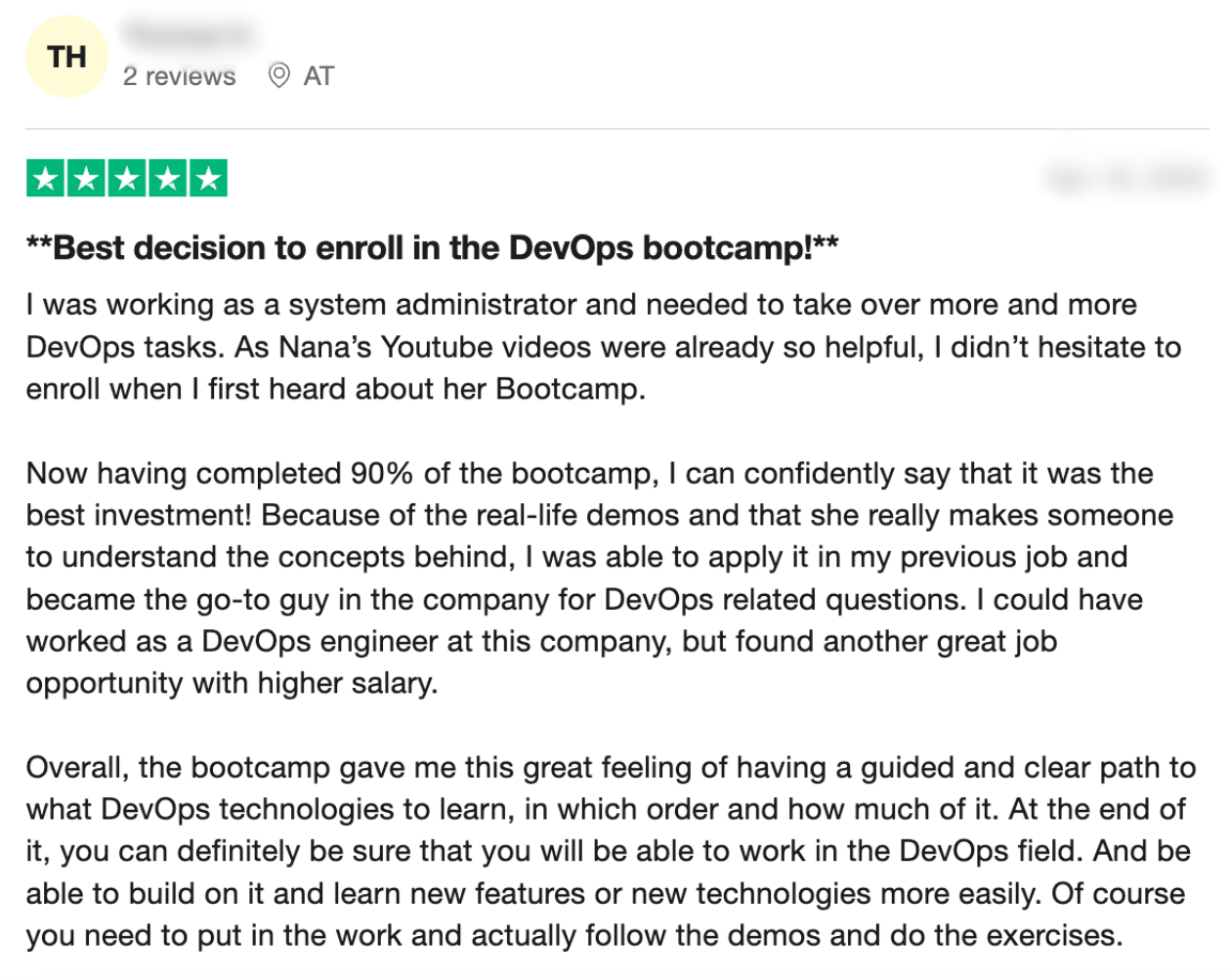
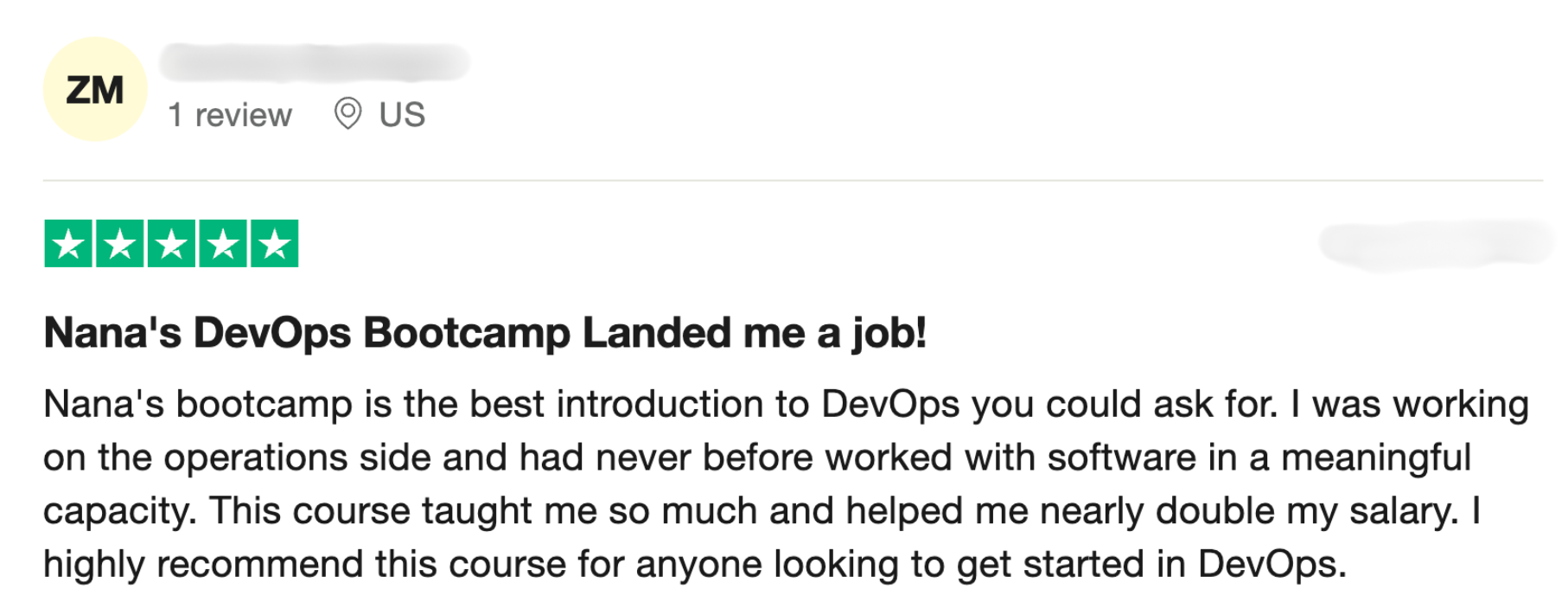
On Landing Jobs and Crushing Interviews

- Our DevOps Bootcamp Graduates -

This is what it's all about.

The job offers. The salary increases.

When interview questions lined up perfectly with what they learned, when they landed roles they didn't think they could get, when their careers took a turn they never expected.

Skills You Can Use on Monday Morning

- Our DevOps Bootcamp Graduates -

The ultimate test of any bootcamp isn't what you learn—it's whether you can actually use it.

Our students don't just talk about completing modules.

They talk about applying concepts immediately at work.

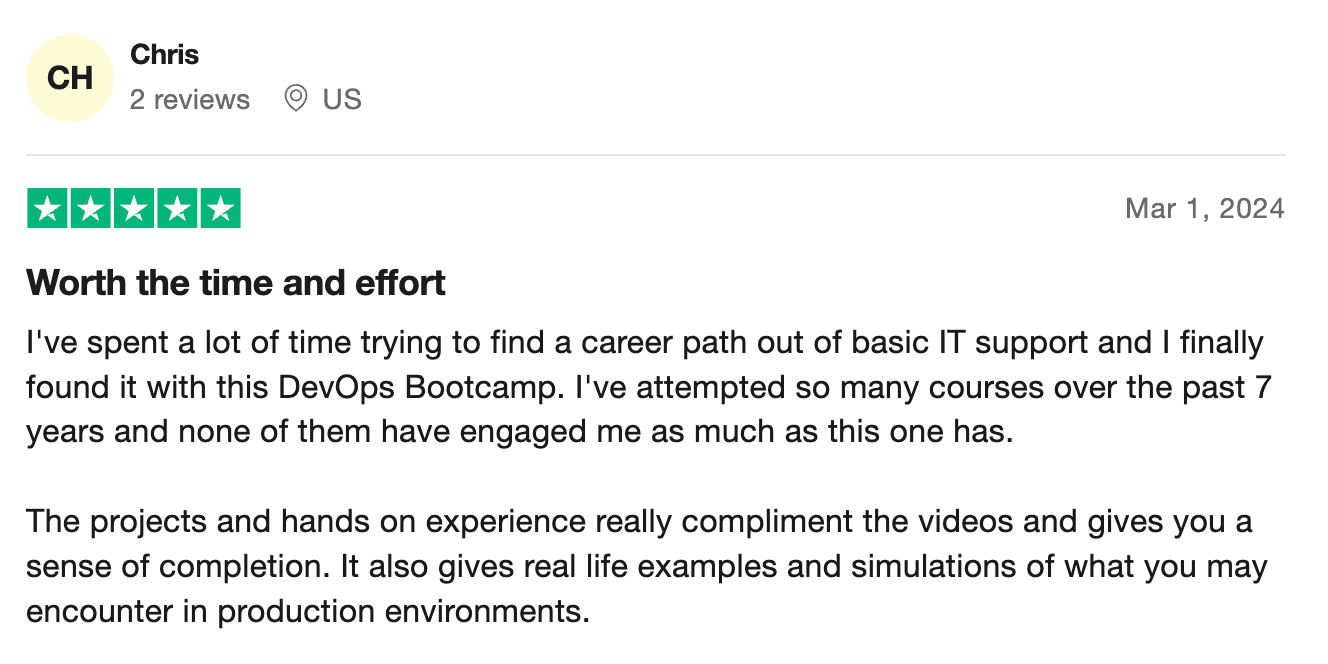
The Struggle Before: Endless Courses, Zero Progress

- Our DevOps Bootcamp Graduates -

We've all been there.

Buying course after course, hoping the next one will finally fill the gaps.

Spending years jumping between tutorials, never finishing anything, always feeling like something's missing.

Our students lived this frustration too.

DevOps Course Curriculum

Overview of DevOps & Cloud Concepts, Technologies and Skills you learn

Download Syllabus as PDF
DevOps Pre-Requisite Concepts

Technologies you learn in these Modules

Linux, Git, Gradle, Maven, NPM, Nexus

Learning Objectives

OS & Linux Module:

As a DevOps engineer you are responsible for preparing the infrastructure (servers) on which the application is deployed. So fundamentals of Operating Systems, Linux and feeling comfortable using the CLI is crucial. In this module you'll learn everything you need for your DevOps or Cloud job.

Version Control Module:

DevOps is all about automation and you write all these automation logic as code. You manage this code and configuration files with a version control tool.

In this module you'll learn the most popular one: Git. Throughout the bootcamp you'll use Git to save your work in your Git repositories, so by the end you'll feel comfortable using it.

Build Tools Module:

You'll learn how to build and package an application with build and package management tools as well as how to execute tests. In this module you'll do it manually, to have the underlying understanding before you'll automate it in later Modules.

Artifact Repository Manager Module:

Artifact Repositories is an important element in the DevOps process. So in this module you will learn a popular artifact repository manager: Nexus. You will learn the general concepts, how it works and how to configure artifact repositories. Later you will learn how to integrate it in a complete CI/CD pipeline.

Continues Integration & Deployment (CI/CD) Pipeline

DevOps Technologies you learn

Jenkins, Jenkins shared library, integration with container registries, integration with various cloud platforms, integration with Kubernetes clusters, installing various tools

Learning Objectives

CI/CD with Jenkins Module and as part of various other Modules:

Continuous Integration and Continuous Deployment is the heart of DevOps. As CI/CD platform we will use Jenkins, which is heavily used at companies. But the CI/CD concepts you learn, are transferable to any other CI/CD tool.

Throughout the bootcamp, you'll learn how to build various production-grade CI/CD pipelines. Building release pipelines to automatically:

  • deploy application to AWS infrastructure
  • deploy container to AWS infrastructure with Docker Compose
  • deploy container to EKS cluster
Containers and Container Orchestration

DevOps Technologies you learn

Docker, Kubernetes, Docker Hub, Nexus, Docker registry, ECR, Helm Charts

Learning Objectives

Containers with Docker Module:

Containers are the new standard in modern systems and Docker is the most popular container technology. This means you need to generally understand concepts of virtualization and containers.

So in this module you'll learn everything to get a full picture of containers and how to work with containers using Docker.

Container Orchestration with Kubernetes Module:

Kubernetes (K8s) has become a standard runtime for modern applications in cloud. K8s is also a very complex framework, in the bootcamp you'll learn everything in an easy way and become proficient in it.

Kubernetes on Cloud - AWS EKS Module:

You'll learn advanced knowledge of EKS clusters and set up production-grade CI/CD pipeline deploying to EKS

Cloud Platforms and Cloud Infrastructure Automation

DevOps Technologies you learn

Digital Ocean, AWS - IAM, ECR, EKS, VPC, EC2, S3

Learning Objectives

Companies are using virtual infrastructure on the cloud, instead of managing their own infrastructure.

Introduction to Cloud and Cloud Concepts Module:

In this module you'll learn about cloud concepts in general, how to set up a simple virtual server on a cloud and how to deploy an application. This gives you a first introduction to this topic.

AWS Services Module:

Learning AWS in-depth. AWS is the most powerful and widely used cloud platform, but also one of the most complex ones. So understanding the core services of AWS and how to build a proper infrastructure using various AWS services is an essential skill set of a DevOps or Cloud engineer that you learn here extensively.

DevOps Automation Tools - Infrastructure as Code and Programming

DevOps Technologies you learn

Terraform, Python, Ansible

Learning Objectives

Infrastructure as Code with Terraform Module:

Manually creating and maintaining infrastructure is time consuming and error prone. In DevOps, we want to automate as much as possible and that's when Infrastructure as Code comes into the picture.

In this module you'll learn the most popular IaC tool: Terraform. First you'll learn Terraform concepts and syntax and how it works in-depth and afterwards use it for more advanced use cases like how to automate provisioning EKS cluster with Terraform and integrate Terraform in CI/CD pipeline to automate the whole process by combining all previously learnt concepts and tools.

Programming Basics with Python Module:

As a DevOps engineer you may need to write automation scripts or small applications to automate tasks for which you need more flexibility than specific IaC tools can provide it.

So in this module you'll learn programming basics with Python as one of the most popular and widely-used programming language. Knowing a programming language makes your skillset well-rounded and extensive, which will help you stand out among other DevOps engineers.

Automation with Python Module:

After having learnt the core programming concepts and syntax, you will now learn how to use this Python knowledge for DevOps use cases and write several automation scripts to get some hands-on real-life experience.

Configuration Management with Ansible Module:

As a continuation of the projects in all the previous modules, we will use Ansible to further automate and optimize DevOps processes.

Ansible, next to Terraform is one of the most popular infrastructure as code and configuration management tools currently used in IT projects. Knowing two IaC tools will make you even more valuable.

Throughout the module, you'll learn Ansible core concepts and syntax with hands-on demos.

Essentially you will learn how to map and translate shell scripts and commands into Ansible Playbooks to automate various common tasks in general.

After that, you'll learn more advanced topics and integrations with other technologies.

So as with all previous technologies, you don't learn Ansible just as a standalone tool in this bootcamp, but rather integrated in different technologies, like Docker, K8s, Terraform, Jenkins, AWS and so on, in various real world use cases, as it builds on the previous modules in the bootcamp!

Monitoring and Observability

DevOps Technologies you learn

Prometheus, Alert Manager, Grafana, Monitoring AWS infrastructure, K8s cluster, Third party services, own applications, K8s operators

Learning Objectives

Monitoring with Prometheus Module:

Once software is in production, it is important to monitor it to track the performance, discover problems in your infrastructure as well as application and the K8s environment. In this module you will learn a popular open-source monitoring tool: Prometheus along with the complete monitoring stack, using Alert Manager and Grafana

Enroll Now

Industry Projects

Real-life projects with real environments as you would encounter them at your work

Infrastructure Automation at Scale

project Terraform.pngDocker.pngAWS.pngAnsible.png

Automate provisioning EC2 servers on AWS with Terraform and automate deploying dockerized applications with docker-compose using Ansible by taking advantage of AWS dynamic inventory.

Production Grade CI/CD with K8s

project Kubernetes.pngJenkins.pngAWS.pngEKS circled.png

Deploying to Kubernetes cluster on EKS from a complete CI/CD pipeline with automatic triggering, dynamic versioning for new docker application image.

App Monitoring & Recovery

project Python.pngAWS.png

Write an automated script in Python for monitoring a web application. Notifying about the status and recovering the application if not accessible.

CI/CD with Docker Compose

project Jenkins.pngDocker.pngAWS.png

Deploy to AWS EC2 using docker compose from a complete CI/CD pipeline with automatic versioning, building a docker image.

Dockerize Application Pipeline

project Docker.pngJenkins.png

Dockerize an application, set up a private Docker registry on Nexus for saving the images and setup an end to end CI/CD pipeline to deploy the application.

Deploy Microservices App to K8s cluster

project Kubernetes.pngAWS.pngEKS circled.png

Deploying a Microservices Application into K8s cluster with Production & Security Best Practices.

Monitoring & Alerting in K8s cluster

project Kubernetes.pngAWS.pngEKS circled.png

Configure a K8s cluster with Prometheus monitoring and alerting. Deploy a web application inside the cluster with its dependent services and configure monitoring for it.

Download Full Demo Projects List

How it works - Our 5 Step Method

No matter if you want to ace the interview or get promoted in your existing job, these 5 characteristics of our DevOps Bootcamp will get you there

  1. 01

    Deep Understanding

    of every DevOps Concept and Technology, which leaves you with no knowledge gaps. No copy-pasting, every line of code is explained

  2. 02

    Tons of Projects and Hands-On Practice

    for each DevOps and Cloud technology to build strong confidence.

    Career-Focused curriculum. Everything you learn is applicable at work.

  3. 03

    Getting the big picture understanding

    by learning how to combine the different technologies and concepts to build complete DevOps processes

  4. 04

    Build an extensive DevOps portfolio

    using those real-life production-grade projects you work on throughout the program

  5. 05

    Obtain DevOps Certification

    for additional proof and comes at no cost, because we want you to have everything you need to start your successful career

  6. Go!

    Ready to WOW Recruiters and Co-workers

    You are job-ready from day 1. Everything you learn is applicable in real work projects at any company

Will I be job ready?

weekly emails by techworld with nana

YES, and you're not doing this alone.

Nana will guide you as a mentor with accompanying weekly messages to guarantee you're succeeding

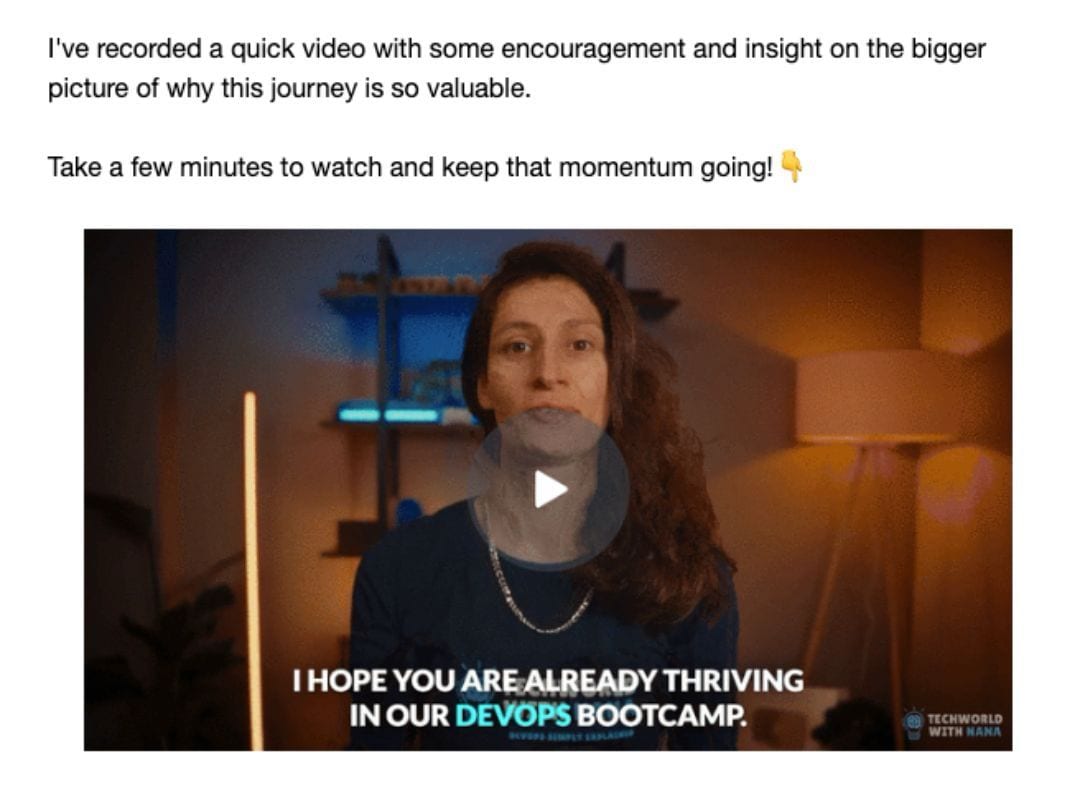
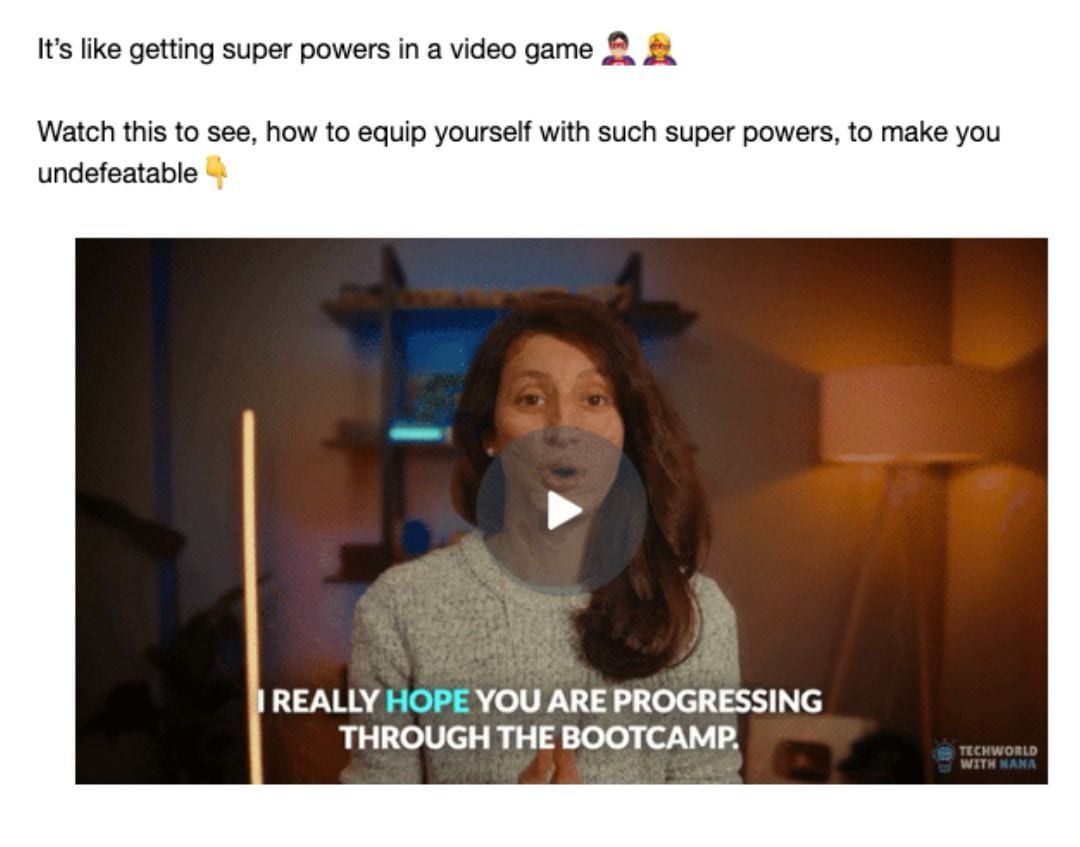
  • DevOps Bootcamp Motivational Videos
    Email: Motivational Videos

    to keep you inspired throughout your learning journey

  • TechWorld with Nana Job Preparation Tips
    Email: Job Preparation Tips

    for building an irresistible engineering profile, Resume and LinkedIn tips etc

  • Job Posts and Career Advice by TechWorld with Nana DevOps Bootcamp
    Email: Job Posts & Career Advice

    Exploring job posts together and matching your knowledge directly to DevOps jobs

And Much More Mentorship

How to create a custom learning schedule, how to use AI to your advantage etc

Investment in YOUR engineering career

To put our price into context 👇

  • An entry level DevOps or Cloud Engineer earns ~$95,000 yearly salary
  • Mid-level DevOps Engineer makes ~$123,000 (You get mid-level engineer knowledge here)
  • Companies pay me $500 per hour as a DevOps engineer to consult their engineering teams in how to implement and build automated DevOps processes in their projects
  • Other bootcamps that do not teach such comprehensive real-life skills cost $4,000-$15,000

Single Payment

Save $100 with single payment

$1,795

Enroll Now!
  • 30-day money back
  • 100% real-life projects
  • 24/7 live support

*Price excludes any applicable VAT taxes

Installment Plan

Pay with 5 easy installments

5 x $379

(in total $1,895)

Enroll Now!
  • 30-day money back
  • 100% real-life projects
  • 24/7 live support

*Price excludes any applicable VAT taxes

What's included in the DevOps Bootcamp

videos.png

16 Modules

  • Video courses with real-life projects across multiple Modules
  • Clearly structured curriculum with an efficient DevOps roadmap
  • Build project portfolio that mirrors actual DevOps tasks
knowledge understand.png

Exercises

  • Exercises with Solutions for each module
  • Additional practice
  • Self-check whether you are able to do tasks independently

Live Support

  • Live Support from experienced engineers
  • Multiple timezones covered
  • 24/7 support including weekends
Bonus #1
TWN DevOps Bootcamp Digital Badge

DevOps Certification

Bonus #2
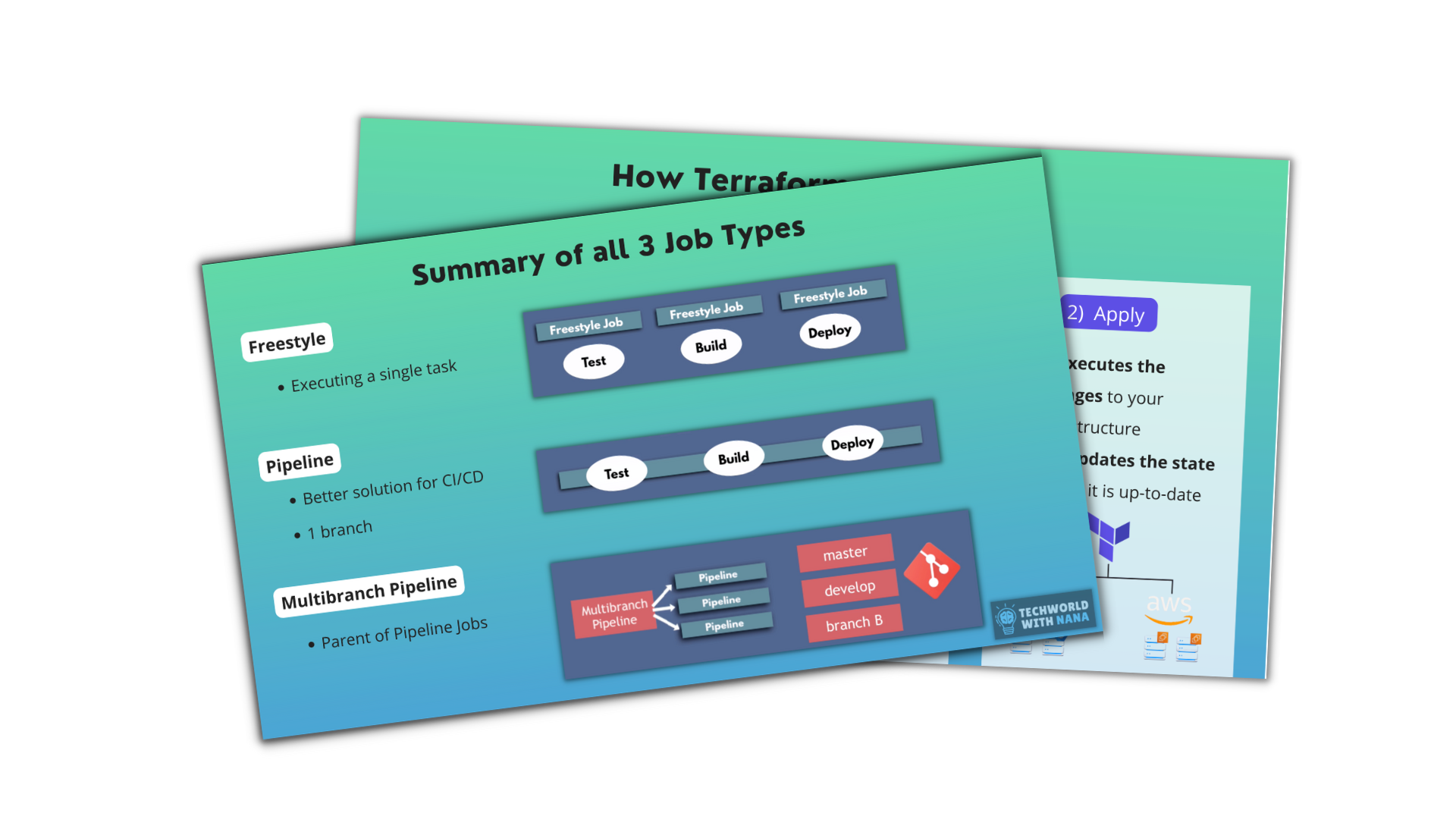
Handouts Preview.png

Study Guide & Handouts

  • Accompanying study guide to stay on track and motivated
  • Accompanying handout for each Module
  • Overview with key takeaways to make your learning even more efficient and easier
Bonus #3
community.png

Community

  • Be part of exclusive Discord community
  • Support in multiple timezones, to guarantee quick reply no matter where you are
Convince your boss

Convince your boss to invest in your education

Almost half of company training budget remains unused. Be sure to ask your employer, whether they will pay for your professional training. We help you in this process. Get quote and "convince your boss" letter

What Graduates Say About Our Program

KOKI Jean-David LinkedIn

KOKI Jean-David

verified

From Systems Administrator to DevOps

"I would like to thank Nana and the team, your DevOps bootcamp allowed me to get a job as a DevOps engineer in Paris while I was living in Ivory Coast, so I tra...

Read more Read my whole story ›
Chioma Ukaegbu LinkedIn

Chioma Ukaegbu

verified

From Production Engineer to DevOps

“After I took Nana’s course, I was confident to attend interviews. I just created a master DevOps resume and applied to companies. I got 2 offers in le...

Read more Read my whole story ›
Amin Yekhlef LinkedIn

Amin Yekhlef

verified

IT Student to DevOps Engineer

"If I didn't do the DevOps bootcamp, it wouldn't be possible to impress him with my knowledge, with my technical skills. And he was also impressed about everything that I did.

Read my whole story ›

Show me More

Any questions?

Feel free to reach out to support@techworld-with-nana.com for any further questions you may have or via below contact form. We usually answer within 24 hours.

Contact Us

Happy to answer any questions you might have!

Other Bootcamps vs TWN Bootcamp

Don't waste your money on expensive bootcamps that don't work

Cost

Other Bootcamps

TWN Bootcamp

Cost $ 4,000 - $ 15,000 (income share agreements)

Only 20% of the price of other bootcamps

Depth of Materials

Other Bootcamps

TWN Bootcamp

Surface level, teaching only to prepare you for interviews

Teaches you ACTUAL technical skills to work confidently as engineer. Acing the interview is a breeze when you know what you're doing

Level of Skills

Other Bootcamps

TWN Bootcamp

Copy-pasting of code, so you miss concepts and deep understanding of tools

Every line of code is explained, deep proficiency in every tool, no knowledge gaps at all

You don't learn underlying concepts and the why's, so you are not able to transfer knowledge to alternative DevOps tools

It's important to us to teach you the underlying concept of each tool to enable you to use any alternative tool in the same category (CI/CD, IaC etc) very easily.

With us, your acquired skills are never wasted, no matter which tool the company you work for uses. This is very powerful!

Duration

Other Bootcamps

TWN Bootcamp

Rush through 12 weeks, which is not realistics time to grasp all DevOps tools properly

Realistic time duration to become REALLY confident in all DevOps concepts and tools

Risk

Other Bootcamps

TWN Bootcamp

Hard to get money back if bootcamp isn't valuable for you - large investment with high risk

100% risk free enrollment, industry standard refund policy of 30 days

You don’t know what instructor you will get, whether they can teach the complex topics to the students in an easy and understandable way

You can check out Nana's teaching style on Youtube and verify if it is understandable for you.

Flexibility

Other Bootcamps

TWN Bootcamp

Mandatory class times and rigid completion date

Flexible to adjust to your life circumstances, learn at your own pace

Access to Materials

Other Bootcamps

TWN Bootcamp

No access to materials after program. Can't review later for on-the-job tasks

Re-watch, get back to the bootcamp later whenever you need to revisit topics for your work

Community

Other Bootcamps

TWN Bootcamp

Lack a lifelong supportive community

Stay part of an exclusive, lifelong supportive community as TWN alumni

Read Chioma's experience, who took other bootcamps before ours Chioma Ukaegbu

Isolated Courses vs TWN Bootcamp

Don't waste your time on endless cycles of courses without a clear path

waste time.png

Roadmap

Isolated Courses

TWN Bootcamp

Endless cycle of courses and tutorials without getting the DevOps big picture

Clear structured roadmap from zero DevOps knowledge to being a job-ready DevOps engineer in ~6 months

Learning Path

Isolated Courses

TWN Bootcamp

Time wasters, learning in wrong order, spending too much time on unimportant tools or concepts

Clear learning path to follow, simply learn exactly what you need, in right order

Depth of Materials

Isolated Courses

TWN Bootcamp

No real understanding of what DevOps tasks look like

Real-life projects, building the complete DevOps processes end to end, step by step

Level of Skills

Isolated Courses

TWN Bootcamp

Focus on teaching a single technology, no complete education for a real job

Focus on teaching you ALL the skills and technologies necessary to work as a DevOps or Cloud engineer from day 1

Community & Support

Isolated Courses

TWN Bootcamp

Experience frustration and get stuck learning solo

Clear structure, supportive community and help from our engineers keep motivation high

REAL skills

Isolated Courses

TWN Bootcamp

Usage of "playgrounds" or "sandbox" environments

Learn by working with real environments, gaining confidence in building from scratch

Roadmap

Isolated Courses

TWN Bootcamp

Fragmented learning -
Not understanding complete picture and end-2-end DevOps processes. Not confident about your skills

Our program is NOT a bundle of courses. Instead in every module, you build the combination of tools and are able to connect the dots and have a clear big picture understanding of all use cases

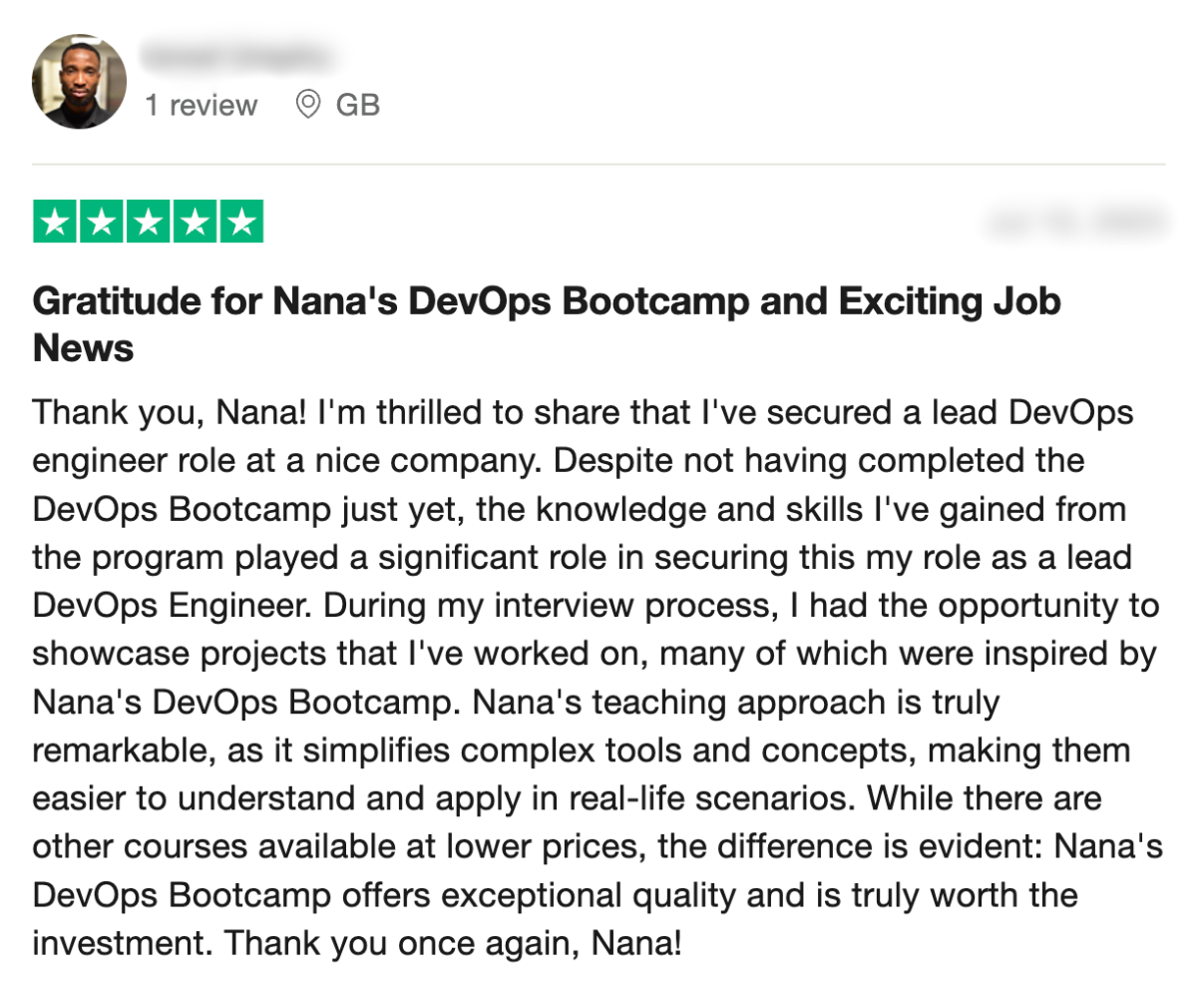
Chris DevOps Bootcamp Review.png

Enroll Now

Career Growth after DevOps Training

The DevOps market is expected to grow by 19% by 2028 and job postings on LinkedIn grew by 50%. Getting a DevOps education now is a great investment into your future, which will pay off very fast!

DevOps Industry Growth

DevOps most sought-after IT skill

DevOps skills are more in demand than any other IT-related skill

#1 Payrank

Highest salaries among all developer roles

Source: info.opsramp.com, Stackoverflow

DevOps Annual Salary

Median
$130,000

Low
$97,500
High
$165,000

Source: talent.com

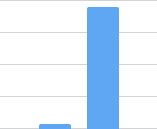
Salary compared to Bootcamp price

Bar chart: bootcamp price compared to a 1-year entry level salary
Bootcamp price1-year entry level

Trusted by companies around the world

Build strong DevOps know-how in your organization to save time and money

  • google icon.png
  • vmware-logo-black.png
  • Red-Hat-logo.png
  • Siemens-Logo-19361.png
  • Volkswagen_logo_2019.svg.png
  • sap icon.png
  • Hewlett-Packard-Company-PNG.png
  • PagerDuty-Logo.wine.png
Rene Heinze LinkedIn Rene Heinze verified

Teamlead Site Reliability Engineering

"I firmly believe that companies should take responsibility for the growth and development of their people. We're committed to this principle, and we've found a powerful way to put it into action with the DevOps Bootcamp from TechWorld with Nana.

This six-month program, meticulously designed by Nana, is our tool of choice to empower the next generation of DevOps engineers in our team. It's comprehensive, hands-on, and perfectly attuned to the real-world demands of DevOps roles.

Looking ahead, we're excited to see what Nana will bring to the table next."

Cedric Bernard LinkedIn Cedric Bernard verified

DevOps Team Lead

"This DevOps Bootcamp is an awesome training for teams to learn or improve key DevOps skills and apply those directly in their projects.
For example, I was able to design a new DevOps framework from scratch within one week without any big painpoints although the technologies were not used before. It was a really nice feeling!

I was not only able to deep dive into existing technical items my DevOps team is using on a daily basis (Jenkins, Kubernetes, Prometheus,...), but I was also able to learn new skills, which allow me to raise my skills one step further."

Still having questions?

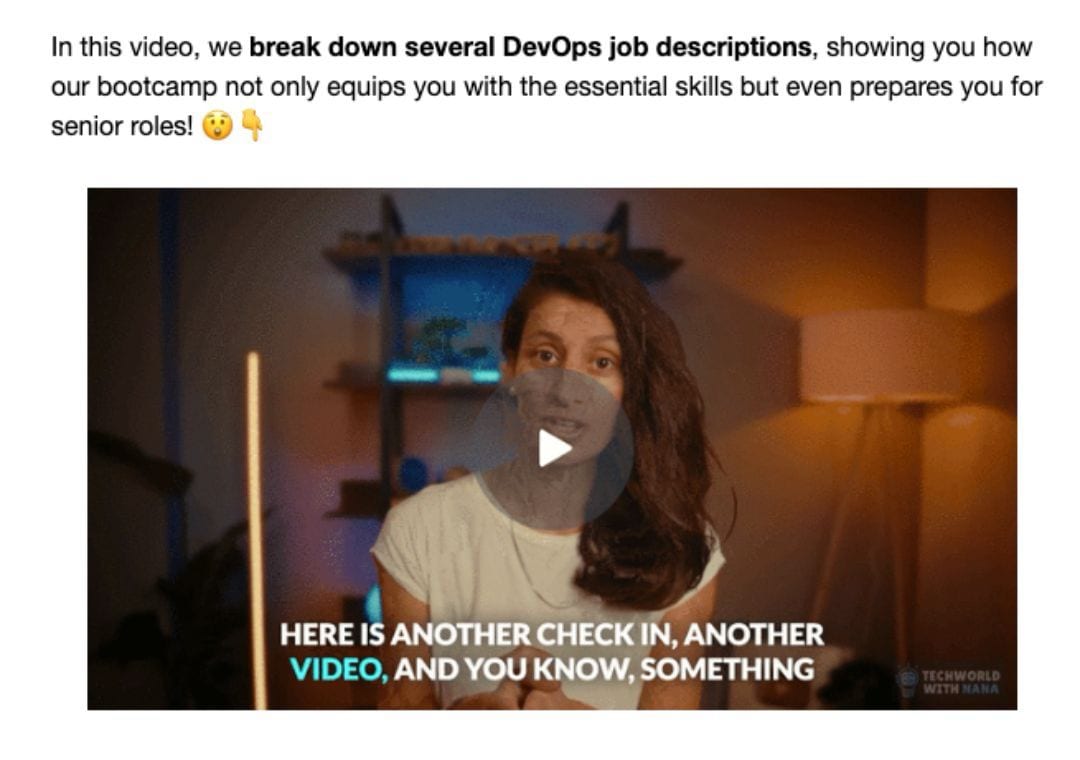
I gathered all the questions and answered them in this video

Frequently Asked Questions

Can I work beside the bootcamp?

Yes! The bootcamp is created with working participants in mind, because our participants are often already working as a SysAdmin or Developer transitioning to DevOps or expanding their skills.

That being said, you can work with the provided materials whenever you want. Be it before going to work, on the weekends or late at night. That is up to you.

Am I able to work as a DevOps engineer after completing the Bootcamp?

Yes! The whole DevOps bootcamp was created with this focus of making you a job-ready DevOps engineer.

1) Many of our students manage to successfully get jobs after the training.

Here are some of the things that are helpful for that:

Throughout the bootcamp, you are building actual real-life DevOps processes start to end, so you are actually implementing things, writing pipelines, automation scripts etc. And you create all these as git projects in your repository. And you can then use your git repositories with all our projects in your resume and LinkedIn profile to show your employers what you know and what you are able to do at work.

It makes sense, because employers want to see that you can actually implement DevOps tasks and use the DevOps technologies. So in the Bootcamp we focus on giving you not just theoretic knowledge or irrelevant information for a certificate, but rather practical hands-on skills that you can use immediately at your job.

So again the whole bootcamp was created with the focus of providing real-life demos, making you job-ready for DevOps role as a whole.

But of course for that you need to actively follow along the demos and do the exercises afterwards.

2) Nearly half of our enrollments are from companies, who purchase the bootcamp for their employees to upskill them in DevOps. This also proves that we are teaching the relevant skills, which are actually needed by companies.

In what format is this bootcamp? The ultimate comparison to live classes 🚀

The bootcamp is a structured course of videos, handouts, Git projects etc. It's structured in a way, that you can easily follow them module by module, lecture by lecture, and work through it in a specific order. This guarantees a smooth flow of the learning process for all our students. It's self paced, so you can schedule your learning sessions, watch the videos and work through the hands-on projects at your own pace.

Compared to the traditional way of live classes, this has actually many advantages over live classes, which are often overlooked. So I want to highlight those here:

HANDS-ON WORK

✅ You can rewatch lectures if you haven’t understood something, stop and practically work along the demos

❌ You can't rewatch. In live classes there is no time for doing deep hands-on work. If they do, either instructor is not able to wait for all students to finish certain tasks or you need to wait e.g. 30mins for other students to get the task done and so valuable learning time is lost very easily. Ultimately, you learn much less in this format.

ACCESS OF MATERIALS

✅ You also have access to the materials for 2 years, which is great because you may want to revisit some lectures, when you actually have found a job or when you work on such tasks. In that case you can refresh some of the knowledge or use the videos as reference.

❌ You can’t revisit lectures and demos later at work. So when you finally need to implement stuff, you may have forgotten many things. Also in other self-paced bootcamps you only get access to the materials for as long as the bootcamp takes. So e.g. when they take 4 or 6 months, you will have access for 4 or 6 months, but not for 2 whole years!

VIDEO over FACE

✅ Video format allows us to add engaging and helpful animations that further help to understand complex concepts as well as showcase the demos

❌ You get a presentation by lecturer, either seeing the face (which doesn't add value to your understanding) or they have static slides, which are boring and your mind gets distracted

SUPPORT

✅ Ensuring that students get the support they need, is actually a high priority for us. We have several experienced engineers, who support our students throughout the program through their learning journey. They are from different time zones to make sure students get quick replies. You will be part of a Discord group, where you can ask questions around the clock. You can also see past questions to review and exchange with other students of course.

❌ In live classes you can only ask questions during the live class. And mostly the questions don’t pop up immediately when you hear them, but e.g. only when you actually work in practice with it. So the advantages of being able to ask "live" is not existent.

PRICE

✅ Another big advantage is of course the difference in price. With our education you save $5,000-10,000 and still get a full education that prepares you for a highly-demanded job, which is quite unique and we are proud to be able to provide that! :)

❌ Bootcamp fee is 5-10x higher than ours

INSTRUCTOR

✅ You can check out Nana’s teaching style on Youtube and verify if it is understandable for you. And from feedback from 1000s of students and comments on Youtube, we know that Nana has a unique teaching style that fills knowledge gaps. She explains every detail and concept behind the tools . Understanding the why’s and the concepts behind the tools is what makes you feel confident of your newly acquired skills.

❌ On the other hand, you don’t know what instructor you will get, whether they can teach the complex topics to the students in an easy and understandable way. Whether they teach in a boring way, whether they use complex terms that you don't understand.

How long does the bootcamp take? What does "self-paced" mean?

The bootcamp is a self-paced program, meaning it consists of online videos (and other materials like PDF files), which you can watch whenever you want.

So the program has no start and end date or duration you need to finish.

Duration depends on several factors

How long it takes for you to finish depends on several factors, like your background/experience, do you work full-time or part-time on the bootcamp, how intensely you work along and through the exercises.

Our estimation for someone, who works part-time on it and has a background either in software development or system administration, is 6 months.

So after 6 months you should be ready for your first DevOps job and be done with the bootcamp :)

How do I get most out of this program?

For a successful completion of the program, it's important to watch ALL the supplied resources each week and do ALL the demos that I show you in the videos. Work at your own pace and take time to really understand and practice one module before moving to the next.

In the later modules you will not only learn the technology, but also the combination with the other tools you already learnt in the previous modules. E.g. in the Terraform module you will learn not only Terraform, but also how to integrate Terraform in the CI/CD pipeline.

The most important thing is to practice, practice and practice. It will help you learn faster and give you confidence at work, when applying the technologies in practice.

Regarding exercises:

The way it is structured and meant is, you work through a module, like Jenkins CI/CD module, during the module you work through the demos that I show you. Once you are done with that module, you go to the exercises for that module. The exercises are based on the things you learnt in the module, so it's a way for you to check that you can now independently do tasks with that technology, as well as validate and test your knowledge and how much you learnt. So it's a practice plus self-check.

Exercises have solutions so you can validate your own solutions!

Regarding Support:

On the one hand the dedicated support is there, when something that I show in the demo doesn't work for you, or you get stuck in the exercises, because you are getting an error in something and you need to resolve it etc.

And on the other hand, use the community to exchange information with other participants, ask questions and also help others, because one of the best ways is also by teaching and helping others. :)

Are we using Cloud Platforms or an integrated lab environment in the bootcamp?

A big part of DevOps is working with infrastructure, creating, configuring infrastructure on actual cloud platforms like AWS. So setting them up yourself instead of using a pre-configured lab is part of the learning. Because what is a value of DevOps learning program, if you don't learn how to setup infrastructure on cloud yourself (as you would ACTUALLY do in a real job) and instead use a lab?

So we are going to be creating and using virtual servers on cloud for various real-life projects in the bootcamp. For those remote servers, we are gonna use 3 different cloud platforms:

  1. Linode - you get $100-200 credit when you create an account and it should be enough for completing the relevant demos, so you shouldn't have any additional costs for using this cloud platform in the bootcamp

  2. Digital Ocean - you also get $100 credit when you create an account. Here you may go little beyond that credit, because we use a droplet to run Jenkins there and Jenkins actually runs throughout the whole bootcamp, because we are learning how to build a complete CI/CD pipeline with many tools. So we will be needing Jenkins for a big part of the bootcamp duration. But we are using Ubuntu server for it, so essentially you can use any other platform or your own server or a company ubuntu server for it. It doesn’t have to be Digital Ocean.

  3. The third and mostly used one in the bootcamp is AWS. We use AWS in many modules, AWS itself, EKS, Terraform and Ansible to learn how to provision and configure servers on AWS. So even though AWS has a free tier, we will be using compute resources and AWS services that go beyond that free tier, because LEARNING these services are part of the course itself. This means you will be charged for the AWS infrastructure, like EC2 servers and EKS service. You can see their pricings on the AWS website.

Understanding pricing and Tip for saving costs

Now it's important to understand, that on cloud platforms you pay for the duration of servers used. So if your server is running for 2 weeks, you pay for that 2-week period. So some students, if they have longer periods of time between learning sessions and don't want to be charged or use the free credits for that time, they delete the servers and recreate them when they continue learning. Or in case of AWS, just stop and restart them, because you don’t get charged for the stopped or not running servers on AWS. A bit of inconvenience, but you will save lots of money this way.

What are the pre-requisites?

KNOWLEDGE:

As DevOps overlaps with Development and IT Operations processes, you should have some kind of IT background.

The DevOps bootcamp is very beginner friendly in terms of the DevOps tools. Also it includes some pre-requisites modules like Linux basics and Programming basics. However, we don't recommend getting into DevOps without having any IT knowledge, because in DevOps you need to automate software development and deployment processes. So if you don't know about these processes, it would be difficult to get started in DevOps right away.

We don't want to exclude anyone, but without having this pre-requisite knowledge, it will be difficult to follow the bootcamp. See "I’m new to IT. I have no IT background. Can I enroll into the bootcamp?" question for more infos.

TECHNICAL:

See "System Requirements" question.

System Requirements

Nana uses MacOS throughout the bootcamp, so it’s desirable to have either MacOS or Linux, to follow along easily. Plus, as a DevOps engineer, you will benefit a lot from working with Unix (Linux or MacOS) on a daily basis.

However, many of our students have Windows and they are still able to work through the bootcamp.

In terms of compute resources, most of the demos are on Cloud Systems (see the "Are we using Cloud Platforms or an integrated lab environment in the bootcamp?" question on Q&A), which means we need less on local resources, since we install things like Jenkins, full K8s cluster, Nexus etc on remote cloud servers, and not on a local machine.

However you still need some amount of compute resources for several other things. For example, we install a Virtual Machine in Linux module. We also install and use some tools, like Docker, Minikube, Visual Studio Code locally.

So you need to have enough RAM (min 4GB), CPU working working properly with these tools.

On Windows you need more, because the Windows OS itself requires more resources than MacOS or Linux.

I’m new to IT. I have no IT background. Can I enroll into the bootcamp?

If you are completely new to IT, then it will be very difficult to work through the bootcamp. Our bootcamp is mostly beginner-friendly, but if you have zero IT background, then it will be very challenging for you.

In that case, we recommend people to join our bootcamp, once they know at least conceptually how software development works, what IT roles there are and basically have an understanding of what the manual processes are that a DevOps engineer tries to automate and make more efficient.

Usually DevOps engineer is not the first IT job people have, but rather a role they transition to, if they are already software developers, system administrators, test engineers, network engineers etc.

Having said that, we do have some students with little IT background in our bootcamp, who have started as junior DevOps engineers after completing it. So it is possible, but it will be much more challenging, and you would need to put in a lot of time and effort to learn.

IT Beginners Course - Pre-Bootcamp Course

As we noticed this huge interest for our DevOps bootcamp from non IT people , we started working on a "Pre-Bootcamp" course, which will make it easier to join and become DevOps engineers. We see this huge demand for DevOps engineers daily and it would be a pity to exclude so many motivated and talented people, who truly want to transition to IT and DevOps specifically.

So in this course, we teach you everything you need to be able to start our DevOps bootcamp.

We decided to create this course ourselves, because we couldn't find any such preparation course on the internet, which we could recommend you to take before. So this course is very special and unique, because we tackled and solved this difficult task of giving you real world insights of how software development and deployment processes work in practice.

You can find more information here: https://www.techworld-with-nana.com/it-beginners-course

Is this bootcamp suitable for my company to upskill my employees?

Yes, half of our bootcamp and course purchases are from companies, who build out their internal DevOps know-how with our educational content.

Most of which are actually suggested by the employees themselves, as they appreciate Nana’s outstanding teaching style and hands-on demos, leaving them with no knowledge-gaps as well as knowing clearly how to apply the learnt skills right away in their work.

Companies appreciate it that employees don’t need to be sent away for several months to complete the training, but instead they can learn the skills next to their job. It’s self-paced, meaning the employees can watch the materials whenever they have time for it and re-watch specific parts, when they work on that specific task. The time and eventually money saved is huge, because the engineers don’t get stuck for hours or even days, trying to find the solution across the internet.

Is the DevOps Bootcamp up-to-date?

YES!

We’ve all been there—struggling through outdated courses or tutorials that waste our time and money. It’s frustrating and unproductive.

So from day 1, we made it a core principle of our programs to keep our curriculum fresh and relevant and fully focused on delivering the best learning experience for our students.

These are two types of updates:

1) Continuous Urgent Fixes:

When a demo breaks, e.g. when a new technology version is released, we jump on it immediately. Whether it’s fixing broken demos or addressing compatibility issues, these updates ensure you’re never stuck with something that doesn’t work.

2) Complete Bootcamp Updates

Beyond fixes, we periodically re-record the entire bootcamp to incorporate the latest technology versions—whether the content still works or not. This proactive approach ensures that you’re always learning with the most up-to-date tools.

Why it's so important to us?

Each year, thousands of new students join us and our goal of getting them job-ready stays the same. So it’s our responsibility to ensure our programs stay up-to-date and aligned with real-world needs to help them achieve that!

How long do I have access to the Bootcamp materials?

You will have access to the bootcamp AND the daily professional support for 2 full years. This duration is much longer than what it takes to complete the bootcamp (which is 6 months, part-time), so even if you need to take several breaks in between, there will be enough time to complete the program 😊

But the great news is that, we provide an option to extend the access to the materials as well as the daily support. So you don’t have to re-purchase the bootcamp after 2 year access expiration.

Plus, after 2 years, you automatically become an honorary member of our TechWorld with Nana alumni group 💪

What if I am unhappy with the bootcamp?

Generally if something is unclear or you have problems with the bootcamp, we will try to support you immediately to answer all your questions. We are also happy to hear your feedback or criticism immediately, so we can fix it for you.

However, if you are still unsatisfied with your purchase, you can request a refund within the first 30 days.

Check out our refund policy here: https://www.techworld-with-nana.com/terms-bootcamp

To ask for a refund, just send us an e-mail at bootcamp@techworld-with-nana.com

Please include the reason why you're asking for a refund and the email address you use for your DevOps Bootcamp account.

We are always improving the bootcamp and adding more value based also or especially on student's feedback, so we would like to know what we can do better.

Download the Syllabus for the DevOps Bootcamp

This brochure provides a detailed overview of our Certified DevOps Practitioner Program

* indicates required

Download Portfolio of Demo Projects of DevOps Bootcamp

This download provides an overview of all demo projects you will build throughout the Certified DevOps Practitioner Program

* indicates required

Request Training Budget for the DevOps Bootcamp

Almost half of company training budget remain unused. Don't let your career progress stall, simply because you didn't ask! Provide your details in the form, and we'll send you a personalized quote for your company! This will simplify the approval process for your training expenses.

* indicates required